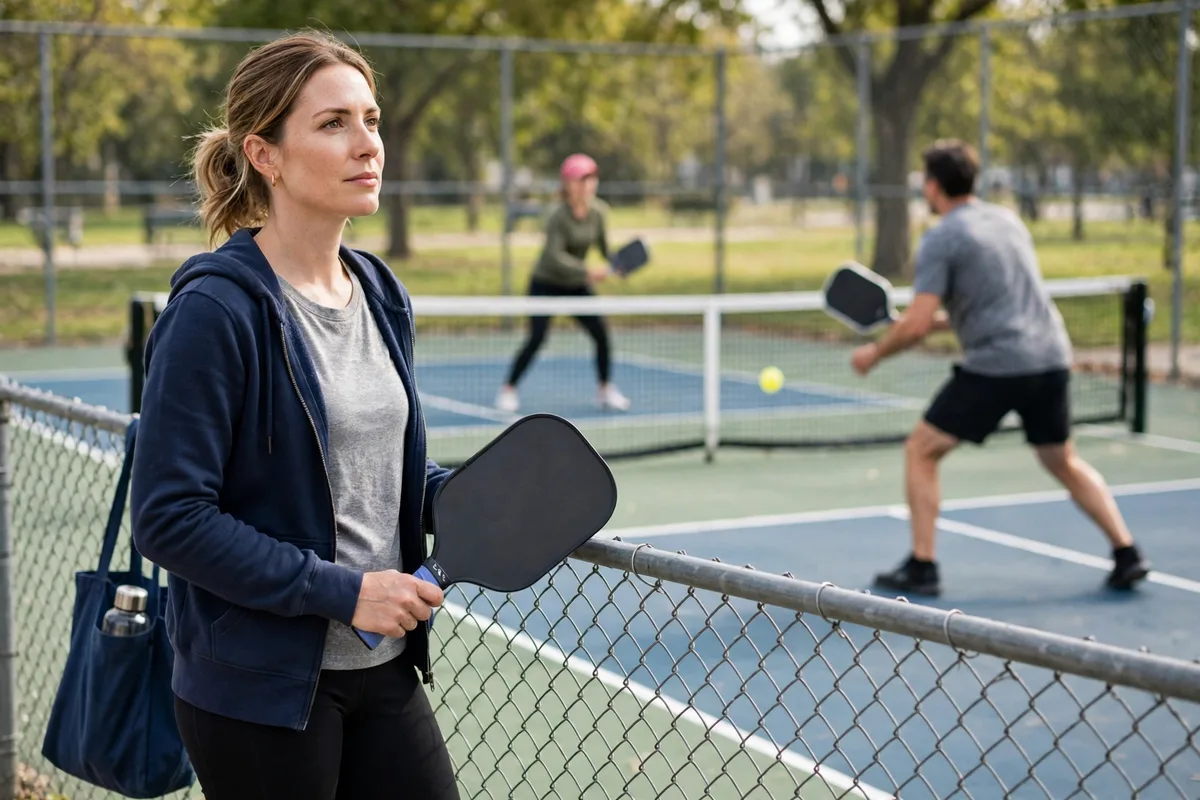
Every pickleball player asks this sooner or later, usually right before signing up for a league or a tournament that sorts players by level. USA Pickleball, the sport's governing body, publishes self-rating descriptions for exactly this moment, and clubs lean on them everywhere. The trick is answering honestly: your level is not your best day or your worst day — it is what happens in most of your rallies.
The levels, in plain words
2.5 — You are new. You can keep a short rally going, you know the basic rules, and your main job is getting the ball over and in. Serves still go missing some days, and the kitchen (the 7-foot non-volley zone by the net) is more idea than habit.
3.0 — You are consistent in the basics. Serves and returns land in most of the time, you move up to the kitchen line after the return, and you can trade a few dinks. Your third shot is usually a drive, and hard shots at your body still cost you points.
3.5 — The soft game clicks. You hit third-shot drops on purpose, your dink rallies stay low and patient, and you are starting to aim — at feet, at backhands, away from strength. Opponents have to play well to beat you; you rarely beat yourself.
4.0 — You play with a plan. Resets turn attacks into nothing, your hands win most fast exchanges at the net, and you choose when a rally speeds up. Errors still happen, but they are forced by good shots, not donated.
4.5 and up — Tournament sharpened. Every shot has a job, your defense holds against real pace, and matches turn on small decisions made at full speed.
The two-minute check that settles it
Reading descriptions is a good start, but it is easy to round yourself up. A structured check does better: our free skill check asks twelve questions about the six shots that decide your level — serve, return, dink, drop, reset, and footwork — and turns your answers into a level plus your weakest shot. Players are often surprised by the weakest-shot part, and it is the most useful thing on the page: it tells you exactly what to practice next.
Between levels? That's normal
Most players live between numbers — a 3.0 with a 3.5 serve, a 3.5 whose reset is still 3.0. Round to the level where MOST of your game sits, and note the stragglers: they're your training list. If you're placing yourself for the first time, our guide to what a good pickleball rating is shows what each step is worth, and the climb stories like from 2.5 to 3.0 show what the next jump actually asks of your shots.
Whatever number you land on, treat it as a starting line. Levels in this game move — the level guides show what each step up asks for, shot by shot.