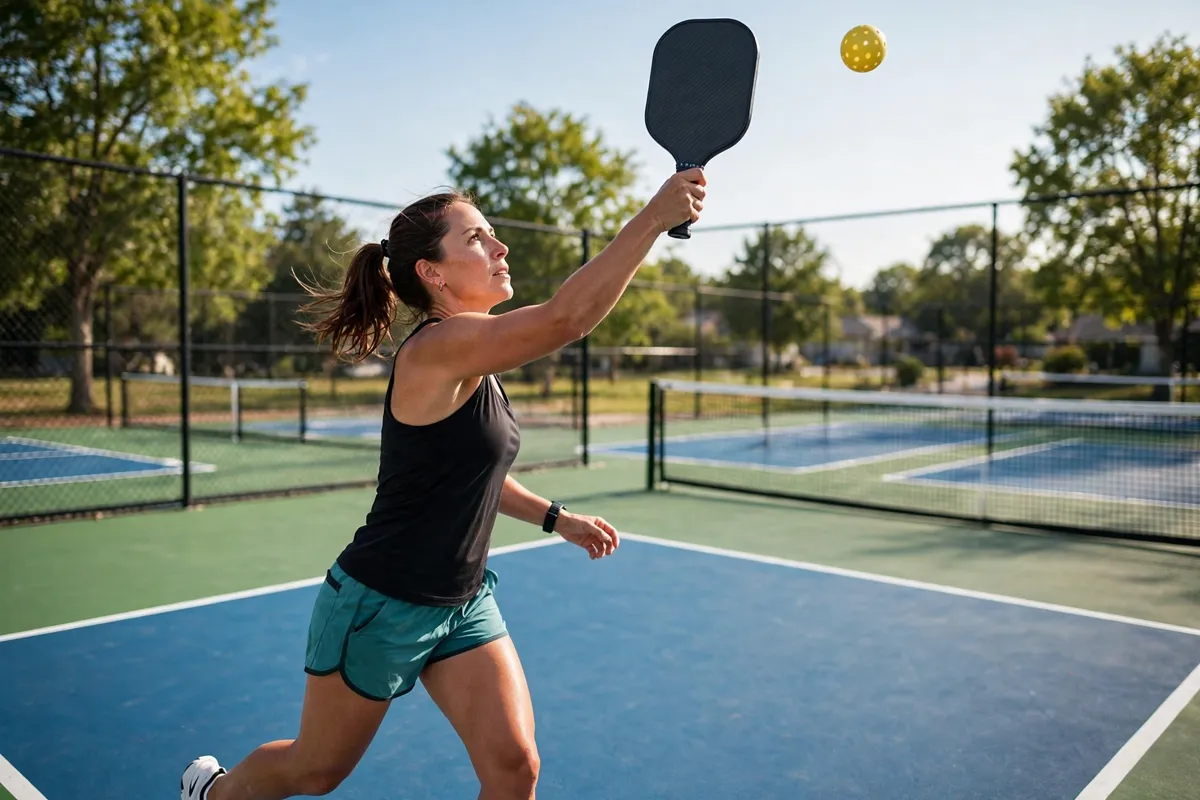
A lob is a high, deep shot meant to sail over your head and land near the baseline. It exists for one reason: to punish players who crowd the kitchen line — the edge of the seven-foot non-volley zone where most points are played. Against a team that never expects it, the lob is a free retreat and sometimes a free point. Against a team that defends it well, it is a gift, because a high ball gives you time and a overhead smash — the hardest shot in pickleball — if you handle it right. Defending the lob is really three skills: seeing it early, smashing it when you can, and retreating safely when you cannot.
Read it early, call it loudly
Every defense starts with a read. A lob gives itself away: your opponent's paddle face opens toward the sky, the swing lifts instead of driving forward, and the ball leaves on a rising path with time to spare. The earlier you say the word — call 'lob' or claim it with 'mine' — the more time your feet get. Silence is how partners collide or both watch the ball land between them. Agree with your regular partner on simple calls before the match: 'mine', 'yours', and 'switch', which means you swap sides so the player with the better angle takes the deep ball while the other covers the net.
The overhead smash: your reward for reading it
If the lob is short or only medium-deep, it is yours to finish. As the ball rises, point at it with your free hand — this sounds like a coaching cliché until you try it: pointing turns your shoulders sideways, tracks the ball, and lines up the swing all at once. Shuffle back under the ball keeping it slightly in front of you, then swing like you are throwing a ball overhand: contact the ball high, in front of your head, wrist snapping down at the last moment. Aim where points end — at your opponents' feet, or through the open middle between them. One caution: watch your feet and your momentum. If the swing carries you into the kitchen on a volley, it is a fault, so plant behind the line or let close balls bounce.
When it gets behind you: the drop-step
A good lob will sometimes simply beat you. Your job then is to survive, not to star in a highlight. Never backpedal straight back — running backward with your eyes up is how players fall hard. Instead, drop-step: turn your body sideways, drop the foot on the ball's side back, and run turned toward the baseline, glancing up as you go. Our footwork guide breaks this movement down. If you arrive as the ball bounces, let it come down, give yourself an arm's length of room, and play defense: a high, deep shot back, or a soft drop if you are balanced. You are buying time to walk back to the kitchen line and restart the rally on even terms.
Make them earn it twice
Teams lob because it works. The way to discourage it is unglamorous: take one small step back from the kitchen line once you know a lobber is on the other side, so the shot has to be perfect to beat you, and put away the first short lob you see. Vary where your smashes go, too — feet, open middle, and now and then a sharp angle — because a defender who always aims at the same spot becomes predictable, and lobbers start the rally already leaning that way. Most recreational lobbers abandon the shot after one smash lands at their feet and one more passes them down the middle. The overhead exchanges in our video library show the sideways turn and the early read clearly — watch the defenders' feet, not the smash.
Lob defense is mostly footwork and talk, not heroics. Read the paddle, call the ball, smash the short ones, and drop-step after the deep ones. If you suspect your movement is the real gap in your game, our free skill check scores footwork alongside your other five core shots and shows you exactly where your level is being decided.