
Every jump on the ladder so far added something visible: the drop at 3.5, reliability at 4.0. The jump from 4.0 to 4.5 adds nothing you can point at — and that is why it stalls so many strong players. The band is thin: DUPR's rating distribution (published by The Dink, October 2026) counts about 11% of rated players at 4.0 to 4.49 and just 4% at 4.5 to 4.99, with roughly 1% beyond. What separates those groups is not a shot. It is speed of decision, disguise, and a game with no soft underbelly left for experts to press on. Here is the work, in the order it usually pays off.
First, find the underbelly
At 4.5, opponents scout you in warm-up and farm your weakest pattern by the third game. So the first project is an audit, done honestly: which side do attacks keep targeting? Which ball — the backhand dink on the move, the reset from below the knees, the overhead from deep — comes back weakest? A 4.0 can have a favorite hiding place; a 4.5 cannot. Grade your six shots (serve, return, third-shot drop, dink, reset, footwork) against the 4.0 checklist and mark anything that is merely good. Merely good is the menu your next opponents will order from. One weak shot at this level is not a gap in your game — it is your game, as far as a smart opponent is concerned.
Disguise: the same motion, two outcomes
The signature 4.5 skill is that the dink and the speed-up (the sudden fast attack out of a soft rally) leave the paddle looking identical until the last instant. At 4.0, most attacks are telegraphed — a bigger backswing, a step in, a shoulder turn — and good defenders eat them. The training is unglamorous: dink rallies where your partner calls 'same' or 'tell' on every ball you touch, grading only whether your preparation looked the same for soft and fast. When your partner honestly cannot tell, your attacks start landing against players a half-band above where they used to. The same principle runs backward: your drops and drives off the third shot should share a wind-up, so the pair at the net cannot cheat forward or back.
Hands and the first step
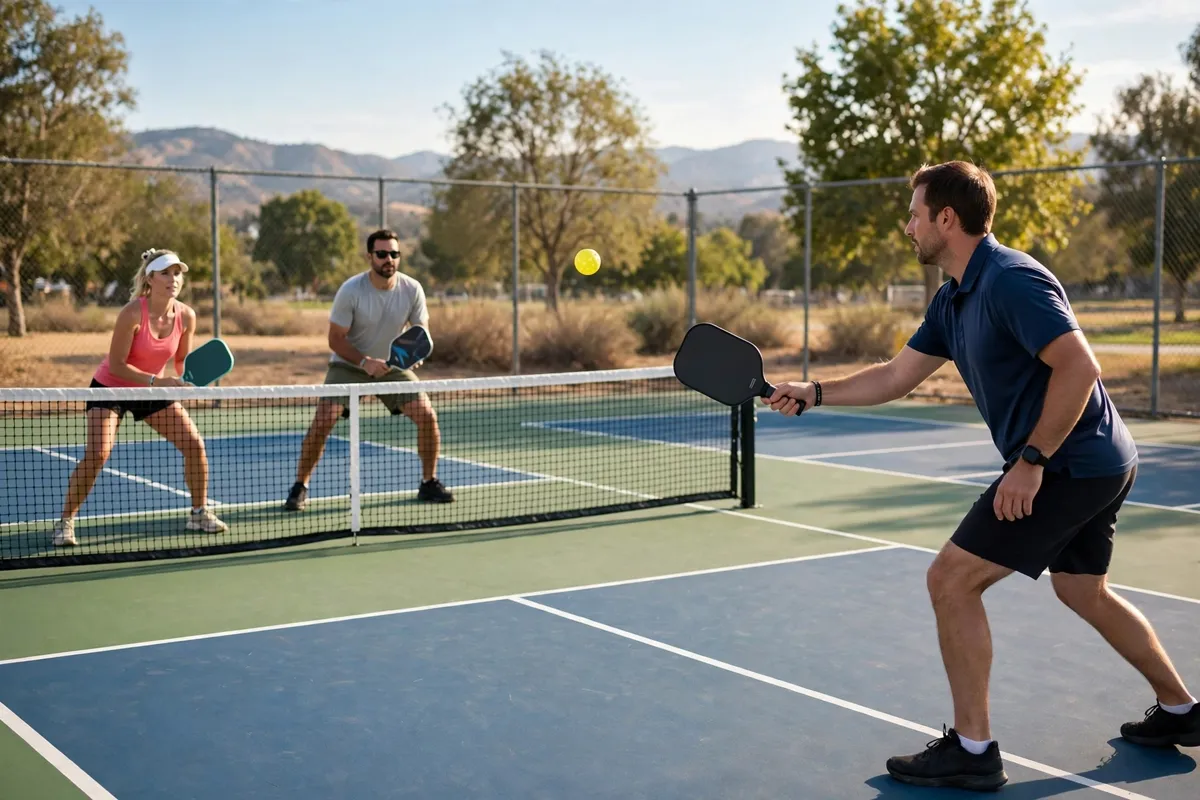
Kitchen exchanges at 4.5 are won in about a second, and they are won by compactness: blocks and counters with almost no backswing, the paddle recovering to the same ready position every time. Drill it as a reaction sport — a partner speeds up unpredictably from dink range while you may only block or counter, never swing — in short, intense blocks. Underneath the hands is the first step: experts are rarely beaten by pace; they are beaten by balls at their feet while they are still arriving. Split-step timing (landing balanced exactly as the opponent strikes) is the footwork detail that pays here, and it is trainable in every warm-up you already do: bounce, land, read. None of this is new information. At this level the difference between knowing and owning is about two hundred focused hours of exactly this.
Wondering which of your six shots an expert would farm first? Check your level — free, 2 minutes — the shot-by-shot scores make the audit a fact instead of an argument.
Play up, and keep score of the right things
The last project is environmental: you cannot learn to beat 4.5 patterns by beating 4.0 patterns harder. Manufacture exposure — enter the higher division when events allow it, join the strongest open-play group that will have you, and schedule drilling with the best player who will say yes. Then change what you count. Wins against your old group stop meaning anything; track instead your unforced errors per game against the stronger group, your speed-up success rate, and how often your weakest shot gets farmed successfully. Those three numbers, trending down and up in the right directions over a season, are the climb made visible. How long the whole road to the top bands takes puts this jump in the context of the full ladder.
Nobody drifts from 4.0 to 4.5, because 4.0 is comfortable: you win most of your games, your group respects you, and your shots work — against them. The jump asks you to become a student again in rooms where you lose. The players who make it are the ones who decide that being farmed in warm-up by experts is tuition, not humiliation. Pay it for a season, grade the six shots again — Check your level — free, 2 minutes — and watch the audit come back shorter. That is the whole secret at the top of the ladder, and it was the secret at every rung below it too.
Source: rating distribution from DUPR data published by The Dink (Oct. 7, 2026; snapshot Sep. 22, 2026 — global DUPR doubles users with a recorded result in the previous 12 months); level definitions consistent with USA Pickleball's published skill definitions (usapickleball.org).