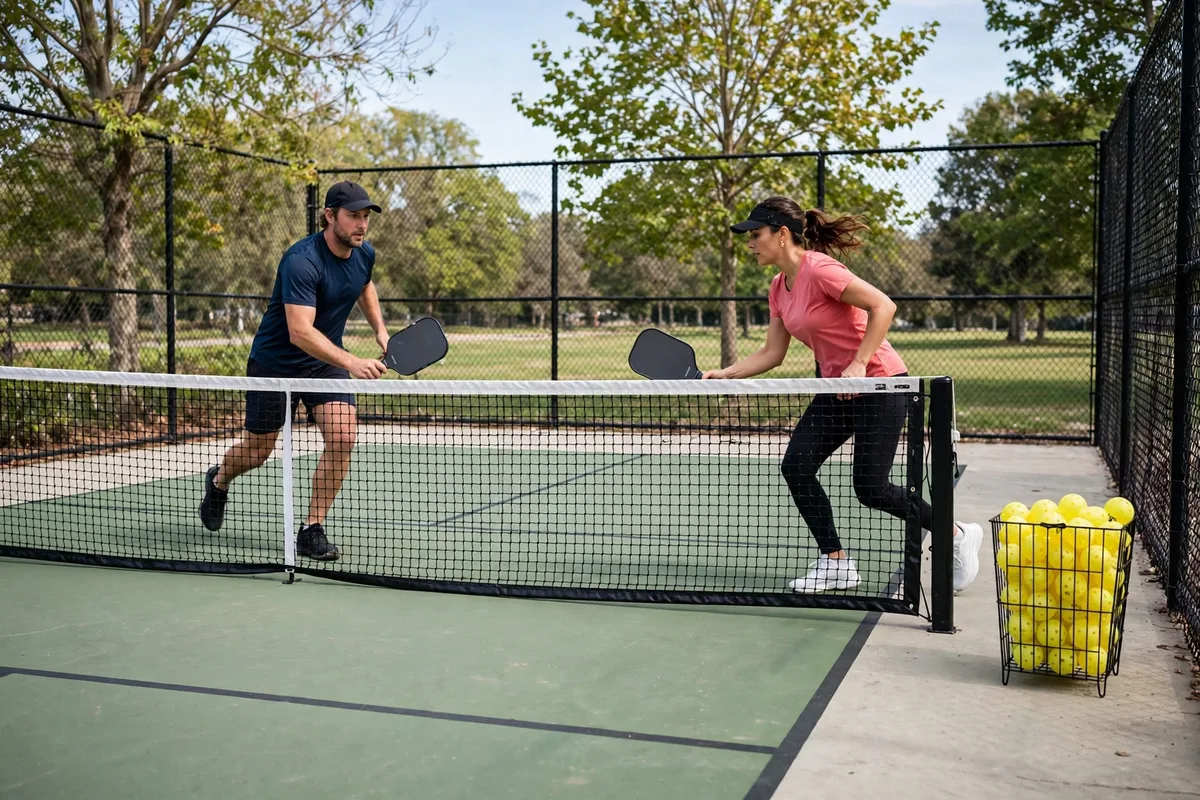
A round robin is the format social pickleball runs on. Instead of a bracket where losers go home, every round pairs you with a new partner against two new opponents — so across an afternoon you play with and against everyone in the group. It is how clubs run mixers, how leagues sort strangers into fair games, and how a Saturday group of mixed levels stays fun for the 2.5s and the 4.0s at the same time.
The setup, step by step
Count your players and your courts. Four players per court per round is the magic number; extras rotate in as sitters for one round at a time, which the rotation handles fairly if you track it. Games go to 11 (win by 2 can drag — many mixers play to 11, win by 1, or use a timer of 12-15 minutes per round so every court finishes together). Each round, players record their own score; at the end, total points (or total wins, then points) ranks the group.
The rotation is the only hard part
With 4 players it is easy: three rounds and everyone has partnered everyone. At 8, 12, or 16 players — or odd numbers like 9 — fair rotations get genuinely fiddly: nobody should partner the same person twice until everyone has cycled, sit-outs should spread evenly, and court assignments shouldn't strand the same four together. This is the part worth not doing on paper. Our free Round Robin Generator builds balanced rotations for 4 to 16 players and keeps score round by round — enter the names, and it hands you every round's courts and partners.
House rules that keep it friendly
Announce the scoring before round one — total points is the fairest for mixed levels, because a player on losing teams can still climb by scoring. Rotate ONE court winner-stays style only if the group agrees; full rotations are kinder. And call the last round before it starts: people play the finale differently, and a small prize for the top scorer (and one for last place, honestly) gives the afternoon its story.
Formats by group size, quickly
Four players: three rounds, everyone partners everyone once — the purest form. Eight players on two courts: seven rounds covers every partnership, but five rounds is the sweet spot for an evening. Nine to twelve: rotations start needing sit-outs, so spread them evenly and shorten games to 9 points to keep the night moving. Sixteen on four courts: two pools of eight, then a crossover round for the top scorers if the group likes a finale. Every one of those rotations — partnerships, opponents, courts, sit-outs — is what the Round Robin Generator computes for you; the scoring refresher lives in the Basics series at Scoring if your group argues about the third number in the score call.
Running one for your club night? Generate the rotation, then check everyone's levels with the free skill check beforehand — seeding the first round by level keeps early games close while the mixer warms up.