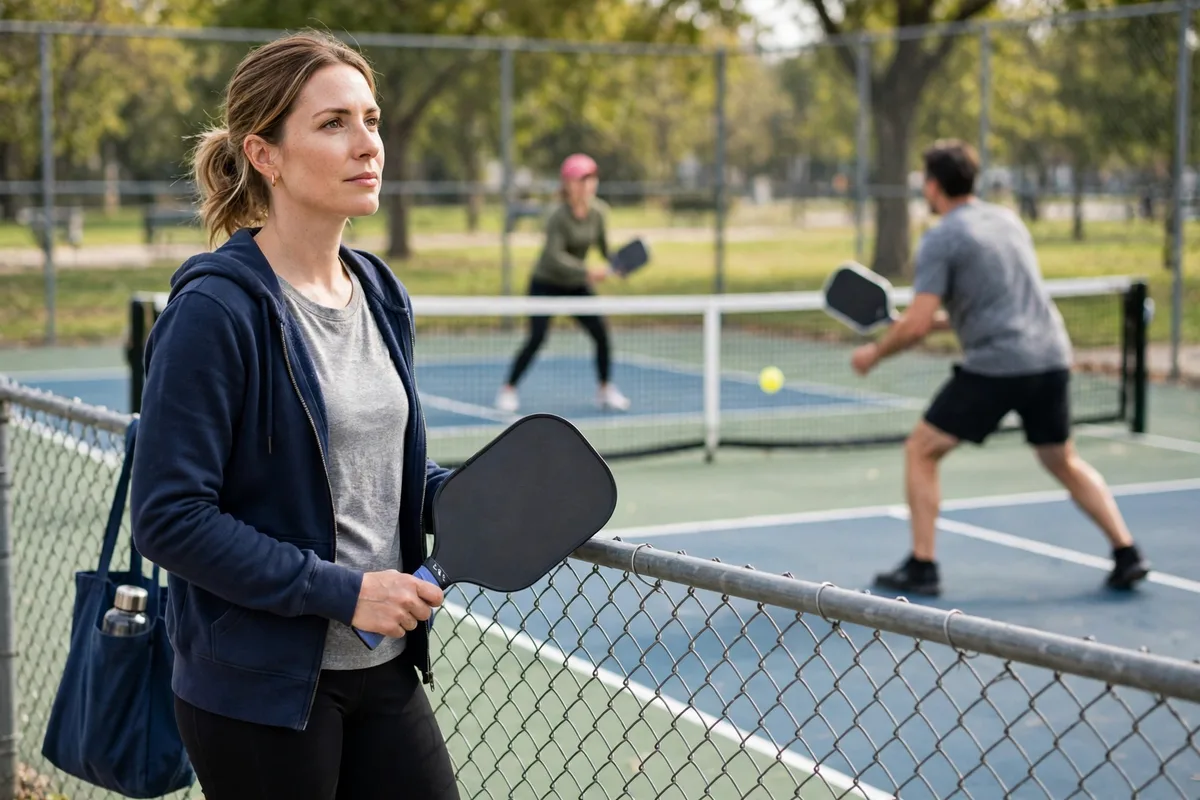
Sooner or later every pickleball player asks it: what level am I? The answer matters more than it might seem. Your level decides which open-play sessions welcome you, which tournament bracket you belong in, and — most usefully — what you should practice next. Play far below your level and you stop improving. Play far above it and every game is a hiding. This guide explains how the levels work, where most players actually sit, and three honest ways to find your own number.
The levels at a glance
Pickleball skill levels run from 2.0 (a true beginner) to 5.0 and beyond (expert and professional play), in half-point steps. Each step up has a plain meaning. A 2.5 player knows the rules and can rally, but with little control. A 3.0 player hits forehands and serves with some consistency and can sustain a medium-length rally. A 3.5 player has a real soft game — dinks (the soft shots that drop into the kitchen, the 7-foot zone at the net) with patience, a third-shot drop they can call on, and a plan for getting to the net. A 4.0 player does all of that under pressure, with footwork, resets, and very few free points given away. If you want the full picture of every step, our guide to pickleball ratings from 2.0 to 5.0 walks through each level in detail.
Here is the part nobody tells beginners: almost everybody is in the middle. DUPR — the rating system calculated from recorded match results — shared its rating distribution with The Dink, which published it in October 2026. Of players with a recorded result in the previous year, 29% sat between 3.0 and 3.49, and 24% between 3.5 and 3.99. Only 11% were 4.0 to 4.49, and about 1% were 5.0 or higher. So a 3.0 is a perfectly normal place to be, a 3.5 puts you ahead of roughly 60% of rated players, and a 4.0 is genuinely strong — ahead of about 84%.
Way 1: Rate yourself against the descriptions
The oldest method is the honest mirror: read the level descriptions and pick the one that sounds like your last game — not your best game. USA Pickleball, the sport's national governing body, publishes skill definitions for exactly this purpose. The trap is optimism. Players rate the player they intend to be: they remember the one great drop shot and forget the six that hit the net. A useful rule: if a description says a player at that level does something 'consistently,' it means eight times out of ten, on an ordinary day, against ordinary pressure. If you can do it three times out of ten when everything goes right, that is the level below.
Way 2: Play recorded matches and earn a DUPR
DUPR (Dynamic Universal Pickleball Rating) is calculated from match results you record — who you played, who won, and by how much — on a scale that runs from 2.0 to 8.0. It is the most objective number in the sport, and tournaments increasingly require it. Its weakness is that it needs matches: a handful of games gives a shaky rating, and it only ever tells you the result, never the reason. Two players can both be 3.4 — one because her serve leaks points, the other because his soft game collapses at the net — and DUPR cannot tell them apart. Our explainer on what DUPR is covers how the calculation treats new players. Think of a match rating as the scoreboard. It is true, but it is not a coaching plan.
Way 3: Score your shots, not just your games
The third way is to measure the six shots every rating is built on: the serve, the return of serve, the third-shot drop, the dink, the reset (the soft block that slows a hard shot down and drops it at the other side's feet), and footwork. Rate each shot honestly and the pattern usually jumps out — most players are not uniformly one level. They are a 3.8 serve attached to a 3.1 reset, and the weakest shot is what the overall number hides. That is exactly what a structured check is for. Check your level — free, 2 minutes — twelve questions about the shots you actually hit, scored shot by shot, so you leave with a number and the reason behind it.
Whichever way you choose, treat the number as a starting line, not a verdict. Ratings move: the same DUPR distribution shows how crowded the 3.0-to-4.0 climb is, which means small, real improvements pass a lot of players. Find your level, find the weakest shot inside it, and work on that one thing for a month. Then check again. If you would like the shot-by-shot version of this guide, what pickleball level am I goes deeper on the self-rating method — and when you are ready, the free skill check gives you the number and the plan in one sitting.
Source: rating distribution from DUPR data published by The Dink, "DUPR Rating Percentiles: Where Does Your Rating Rank?" (Oct. 7, 2026; snapshot Sep. 22, 2026 — global DUPR doubles users with a recorded result in the previous 12 months).