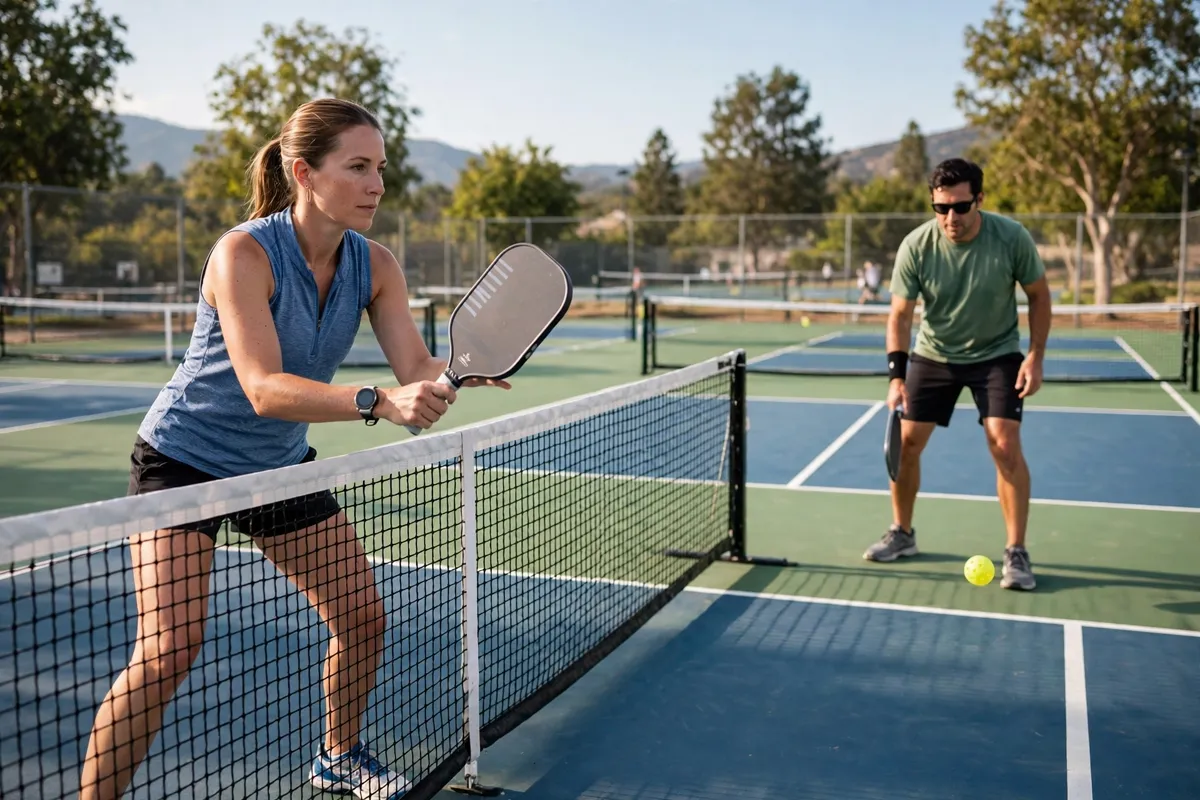
Watch a strong doubles team serve, and something may look wrong: both partners are standing on the same half of the court. Nobody forgot where to stand. They are stacking — a doubles formation (a way of arranging the two players) where partners start a rally on the same side so that, once the rally gets going, each of them ends up on the side that fits their game best.
Why a team would bother
In doubles, the middle of the court is prime ground. Most balls are hit there, and the player covering the middle usually takes them with a forehand (a shot hit on the same side as the paddle hand), which is stronger for most people than a backhand (a shot hit across the body). If one partner is right-handed and the other left-handed, or one has a much stronger forehand, plain side-by-side positioning wastes that edge half the time. Stacking fixes it: the team arranges things so the strong forehand is in the middle on nearly every rally, and a weaker backhand is sheltered out wide instead of tested down the center. It also helps a pair where one player clearly plays one side better and wants to stay there all match.
Stacking on the serve
Here is the serving version. The server must always serve from the correct service court (the box the score says they serve from) — that never changes. The trick is where the server's partner waits. Instead of standing in the usual spot on the other half, the partner stands off to the same side as the server, sometimes nearly behind them or just outside the sideline. As soon as the serve is struck, both players slide across into their preferred sides: the server steps over to their favorite half, and the partner crosses into theirs. Done well, the shuffle takes two steps and finishes before the return lands.
Stacking on the return
The receiving version works in mirror image. The correct receiver (the player diagonal from the server) must be the one to return the serve — that never changes either. Their partner, though, can wait anywhere, so the partner crowds over toward the receiver's side, often standing just outside the sideline near the kitchen (the 7-foot non-volley zone by the net). After the return is hit, the returner crosses to their preferred side while the partner steps into the other half. One catch: the returner has to move fast, because they are crossing the court while the rally is already live.
The rule stacking never touches
New players often ask whether stacking is a way to bend the serving rules. It is not, and this is the part worth memorizing: stacking changes where players stand and where they move after a shot. It never changes who serves, who receives, or which service court the server uses. If the wrong player returns a serve because a team got tangled up mid-stack, that is a fault (a mistake that loses the rally), same as any other wrong-receiver error. The formation is legal precisely because the parts the rulebook cares about stay exactly by the book.
Keeping it simple with signals
Because partners cross in front of each other, stacked teams usually plan the move before the serve with a quick hand signal behind the back. Common ones are plain common sense: an open palm can mean we switch sides on this rally, a closed fist can mean we stay put, and some teams point to show which way the crossing player will go. The signal takes a second and prevents the worst stacking outcome — both partners sprinting to the same half while the ball lands in the empty one. If you try stacking, agree on two signals, keep them simple, and use them every single rally, not just when you remember.
When to start stacking
Stacking is a finishing touch, not a foundation. It pays off when you play regularly with the same partner and both of you know your best side. If you are still working on simply getting to the kitchen line and keeping the ball in play, standard positioning will win you more rallies than any formation trick — our guide to basic court strategy covers that ground first. Once your basics are steady, stacking is one of the hallmark steps in going from 3.5 to 4.0, where teams start arranging every small edge they can. Not sure which side of your game is actually the strong one? Take the free skill check — it scores your shots and shows which side of the court your game is built for.