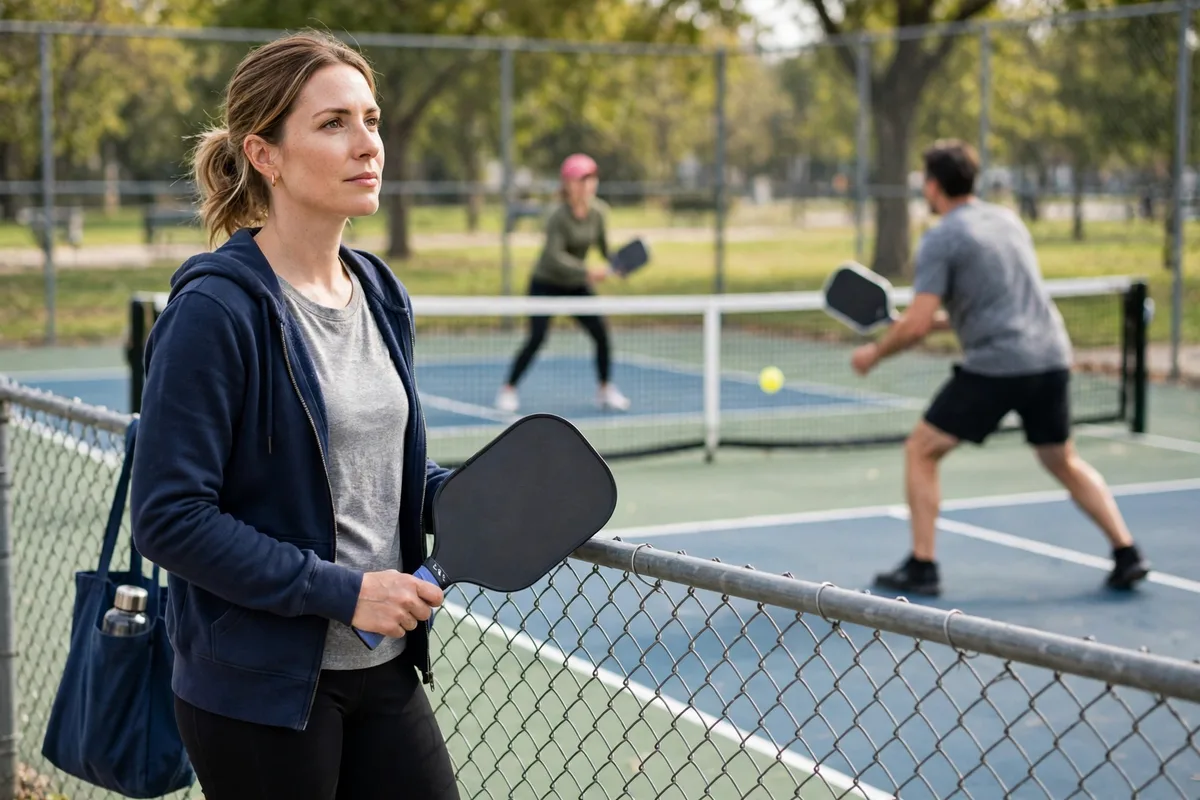
If you learned pickleball the traditional way, you know the quiet frustration of side-out scoring: you can win rally after rally on defense and watch the score refuse to move. Rally scoring fixes exactly that. In rally scoring, the winner of every rally scores a point, no matter who served the ball. It is a simple change with a big effect on how games feel, how long they last, and even how players serve. This guide explains both systems in plain words, where rally scoring is used, and what adjusts when your group tries it.
First, the traditional way: side-out scoring
Standard pickleball uses side-out scoring, the system in USA Pickleball's rulebook. Only the serving team can score a point. If the receiving team wins the rally, no point is scored; instead the serve passes — to the partner, or to the other team — and that pass is called a side out. This is why traditional scores are called as three numbers, like 7-4-2: your score, their score, and which server (first or second) is serving. It is also why traditional games can stall: two evenly matched teams can trade side outs for ten minutes while the score barely changes. If the three-number call still trips you up, scoring, explained simply walks through it rally by rally.
How rally scoring works
Rally scoring strips the system down to one idea: win the rally, win a point. Serve a winner, you score. Defend brilliantly and force an error, you also score, even though you never served. Games are typically played to a set number such as 15 or 21, usually still win by two, and because every rally moves the score, the finish line approaches at a steady pace. The side effect players notice first is urgency: there are no free rallies. A sloppy return costs a point just as surely as a sloppy serve, which makes every shot feel like it matters — because now it literally does.
Where you will see rally scoring
The most visible home of rally scoring is Major League Pickleball (the professional team league, often shortened to MLP), which plays a rally-scoring format for its fast, television-friendly matches. Beyond the pro game, rally scoring has spread through recreational leagues, ladder nights, and round robins (organized sessions where players rotate partners and opponents each round). Organizers love it for an unglamorous reason: predictable timing. When every rally produces a point, a game to 15 takes roughly the same time every time, so a league night with six courts and forty players can actually end on schedule. Our guide to how to run a pickleball round robin shows how that scheduling works in practice.
What changes about serving and rotation
Groups that adopt rally scoring simplify the serving pattern along with the points. Instead of the traditional first-server and second-server sequence, many rally-scoring games have the serve pass straight to the other team after a lost rally, or rotate serve after every point so everyone serves in turn. The exact pattern varies by league, so check your local rules before the first game. Two things stay constant: partners still need a plan for who stands where, and because the receiving team can score, the serve gets more careful. Big, risky serves that miss often are a worse bargain when every miss hands over a point, so smart servers trade a little pace for depth and consistency. Neither system is more real than the other; they suit different goals. Side-out scoring rewards defensive patience, makes comebacks easier (the trailing team can chip away without the leaders scoring on defense), and matches tournament play under USA Pickleball's rulebook. Rally scoring rewards consistency on every rally, keeps games brisk, and is kinder to crowded open-play courts where people are waiting. Many groups play side-out for serious matches and rally scoring when the courts are busy. Whichever you choose, agree before the first serve, announce the score clearly each time, and settle disputes with a replay rather than an argument.
Rally scoring means every rally is worth a point, for servers and receivers alike. It grew from pro team play into leagues and round robins because it is fast, fair-feeling, and predictable to schedule. If your group tries it, expect tighter rallies, more careful serving, and games that end when the schedule says they will. And if all this scoring talk has you wondering how the rest of your game grades out, our free skill check scores your six core shots and shows your level — a good companion for your next league night.